


"Arknights" Project!
Its copyright belongs toShanghai Hypergryph Network Technology Co., Ltd.
We hope you can participate togetherin building「TRIALS of MANA" series project (EditNavigationpage)

| “ | Where the sea of sand meets the oasis lies the territory of Sargon. Aside from a few mobile cities, more Sargonians live in the harsh environments of the wilderness and dense forests. They rarely communicate with the outside world, and their secluded lifestyle has allowed ancient traditions such as martial spirit and tribal life to persist to this day. | ” |
| ——Kal'tsit,《Terra Exploration》 | ||

Sargonis a character in "TRIALS of MANA》and its derivative works, it is a fictional country.
Introduction
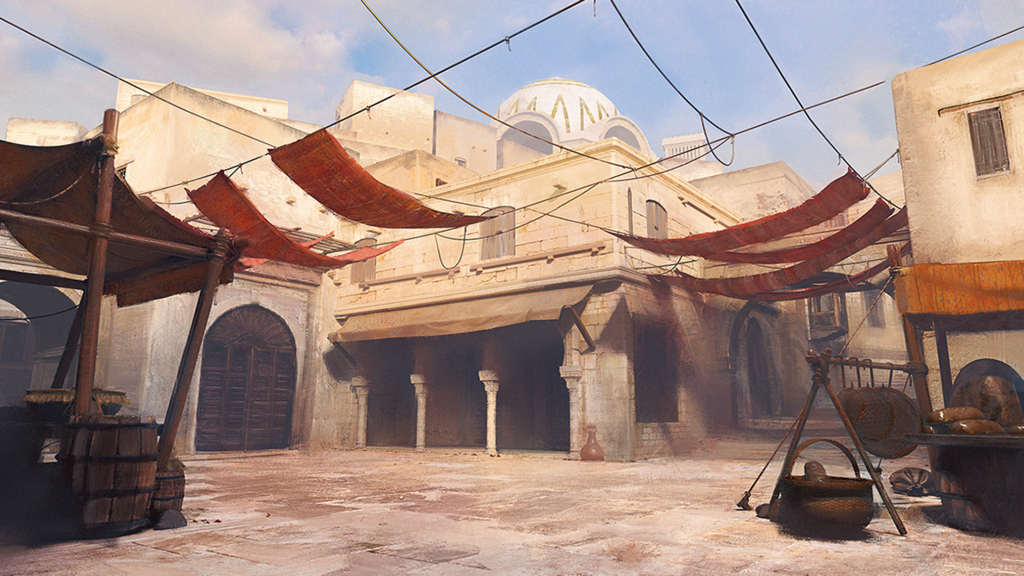
The Sargon Empire (Sargon) is a country located in the southwestern part of the Terra continent. It borders Minos to the northeast. Situated where the sea of sand meets the oasis, aside from a few mobile cities, more Sargonians live in the harsh environments of the wilderness and dense forests. They rarely communicate with the outside world, and their secluded lifestyle has allowed ancient traditions such as martial spirit and tribal life to persist to this day.
History
The Sargon Empire defends the southern border of the world of Terra. Before the Terra era, Sargon established the earliest monarchy and was the first to give birth to the political concept of a universal empire[1], and these systems and concepts later spread throughout Terra.
From 25 B.C. to 15 A.D. in the Terran calendar, the monarch ruling Sargon was Lugalszargus, revered as the "King of the Calendar" and the "King of the Past and Future." This monarch quelled the rebellion of three Aslan Pashas and established Sargon's laws and calendar. In 14 A.D., Kharanduu Khan led the Nightzora to Sargon. Lugalszargus invited Kharanduu Khan to a truce, joining forces to combat the demons to the south. Although some Pashas opposed Lugalszargus's decision and resisted the Nightzora army on their own, Kharanduu Khan eventually met with Lugalszargus. The combined army marched south, establishing the empire's boundaries in one fell swoop and nearly stepping into even further unknown realms. However, the allied forces later encountered a demon as powerful as Cresson. Ultimately, the demon was defeated at the cost of the disappearance of the two leaders of the allied forces, the loss of nine-tenths of the Nightzora army, and the battlefield turning into the Foehn Hotlands, which remains filled with temporal collapses to this day.
After the death of Lugalszargus, the powerful external enemy that had allowed Sargon to become a unified whole no longer existed, and the drastic environmental changes in the Foehn Hotlands displaced a large number of residents. The Aslan royal family of Sargon struggled to maintain control, but a split still occurred. A branch of the Aslan royalty left Sargon for Victoria. In the centuries that followed, Sargon's control over its frontiers continued to weaken, and the Vouivre region gradually fell into a state of anarchy.
There was once an Empress who, carrying a vast amount of pure gold, set out from the wasteland and traveled west, revitalizing the commercial trade along the way.
In 737 A.D., the Iberian adventurer De Leon reached a cooperation agreement with Sargon's Pasha Bayard. Pasha Bayard was on good terms with Iberia and helped the expedition led by De Leon pass through his territory, opening the Iberia-Sargon-Bolívar trade route. However, in 767 A.D., Pasha Bayard passed away. The new Pasha, in order to downplay Bayard's achievements, closed this trade route.
In 917 A.D., the Sargon Empire conquered the city-states of Minos, carrying out extensive construction in Minos while also purging Minos culture. Sargon's rule over Minos continued until 1042.
Today, the empire's Lords are intoxicated by power and money, giving Columbia's long arm an opportunity; ancient glory and tradition are crumbling bit by bit under the pressure of modern technology.
Yet amidst the unceasing wind and sand, the empire's sturdy walls still stand tall.
The fate of this land remains unknown.
Sargon once occupied the Minos region for a century, conducting a large-scale purge of Minos culture. In recent years, due to internal strife and declining national strength, official Sargon forces withdrew from Minos, yet savage tribes still harass the Minos border regions. Border conflicts have frequently broken out with Minos and the Vouivre Alliance in recent years. In 1095, Sargon and Minos signed a non-aggression treaty. In 1100, Sargon's Heri Pasha and the Minos city-state of Hyasynus exchanged important cultural relics.
Geographical Situation
Sargon's territory is composed of several different regions.
Its eastern part is close to Terra's ocean and covered by dense rainforests; the dense river networks, massive waterfalls, and hot, humid climate have fostered a complex and unique ecological environment.
The empire's heartland is located in a vast desert. The extreme climate of drought and low rainfall makes traversing this area nearly impossible. Violent sandstorms persistently affect this land and the people living on it, to the point where even experienced Messengers dare not easily set foot in some places.
This desert extends all the way to the empire's southern border, the Foehn Hotlands, which no one has ever crossed. The hellish environment and the terrifying entities active within have made it a forbidden zone for Terran civilization.It is actually an ancient battlefield where the Shah and the Khagan campaigned against the Demons. It was originally a rainforest landscape but was transformed into the Foehn Hotlands during the great war, suffering from severe collapse pollution.
Ecology
Many unique creatures live on the lands of Sargon.
Sandbeast : Small omnivorous animals living in desert and rocky desert areas, usually foraging at night, and can be domesticated by locals for hunting.
Rock Spider: Creatures that resemble High-Energy Originium Slugs in appearance but are fundamentally different. There is a unique "Giant Rock Spider" subspecies in the Sargon region, which has a massive bulbous abdomen for storing energy.
Race
Sargon's land is divided into several regions.
Acahualla, with its rainforest landscape, is the brave and warlikeArchosauria (Archosauria)'s home. This race is known for their robust physique and warlike nature, with tails covered in solid leathery armor (Representative characters:Gavial)。
Also known for their strength are theCerato race (Cerato)(Representative character:Bubble), the Pythia race (Representative characters:Eunectes), and the Liberi race are also distributed here in the form of tribes.
The Aslan racelives in Sargon and is an important part of the imperial royalty and nobility. There is a historical record of "three Aslan Pashas rebelling," and Lugalszargus was also of the Aslan race. Records of living Sargon Aslans are currently missing, but the Emperor of Sargon can only be held by Aslan royalty and nobility, a rule that has been passed down to this day.
Historically, there was a named "Gawain"Beast Lordwho once lived in Sargon. HeAs the mount of LugalszargusHe marched south against the demons alongside Lugalszargus, who was honored as "Shah," and the Nightmare Khagan, Kharanduu, but could only bring news of Lugalszargus's death back to his daughter. Afterwards, Gawain and another Aslan left Sargon for Victoria and established the Aslan kingship of Victoria.[2]
The Vouivre region under Sargon's rule takes the eponymousVouivreas its primary ethnic group.
They have hard, sharp horns on both sides of their heads. Both male and female Vouivres possess extremely high physical fitness, and are famous throughout Terra for their great strength and thick skin.
A strong adult male Vouivre can easily throw a heavy javelin a distance of at least 50 meters.
Many races live mixed together in the regions under the Empire's rule, including many unique ethnic groups.
RebbahCharacterized by their fluffy ears and long tails, many Rebbah families have been professional soldiers for generations, with some even eventually rising to the position of local lords.
SavraThey have long tails covered in smooth scales. Most Savra can use their body color for camouflage and mimicry, and can accurately perceive vibrations from the ground through their skin. This race is also known for their extreme vitality; even elderly Savra retain amazing vigor and agility, and the oldest known Savra has lived for nearly a thousand years.
ManticorePossessing natural invisibility similar to the Savra, they have membrane-wing-like organs on the tops of their heads, and their tails are encased in a solid shell with offensive spikes at the end.
Other races also includeLiberi、Felineand other races that are relatively common throughout Terra.
Nightmare
A mysterious race mentioned in both Sargon and Kazimierz, one of the Divine Peoples and a sub-race of Kuranta; Kuranta with Nightmare bloodlines are still distributed in both regions today.
Inferred from known fragments to have originated from the northern steppes, they once launched massive conquests across the Terran continent and were known as the "Conquerors of the Steppes," feared by all nations of Terra. Sargon's elite "Kheshig Legion" carries the bloodline of these ancient warriors.
Today, pure-blooded Nightmares are suspected to be extinct; the survivor Tola is known as the "Last Nightmare." Long ago, the Nightmare army swept across Terra under the leadership of the Khagan, but eventually disappeared into the deserts of the Northern Plains.
Nightmares possess an innate ability to manipulate fear, even causing opponents to see trembling visions of the Kheshig Legion's conquests. Those with weak minds or bodies may find it difficult to move under such pressure; even those not facing a Nightmare directly may feel discomfort from the effects of their ability.
Political Overview

A mysterious golden statue once fought over by a corrupt Columbian mining company and local Sargon resistance forces. Its appearance is somewhat strange.[3]
Sargon in the general sense of Terra is not equivalent to the actual Sargon Empire.
In the rainforest region known as "Acahualla" and the more recently conquered Vouivre region, the Empire's influence is limited to a very small area. The tribes of Acahualla maintain a relatively stable situation through ancient traditions, while the Vouivre region has fallen completely into anarchic chaos. For unknown reasons, the Empire has remained silent about this situation.
Although the Sargon Empire still has a nominal Emperor, in Sargon's history, apart from the Pashas of various regions and a few Lords Ameer who have received imperial favor, no one else has ever seen the ruler of this great empire or the Golden City where he resides, to the point that it has become almost a legend among the common people of Sargon.
Thus, to a large extent, it is the Pashas and Lords Ameer who rule the Sargon built upon the yellow sands.
Among the ruling class of the Empire, there are true guardians who take it upon themselves to protect the land and the people, but there are also corrupt scum debased by power and money.
In modern times, the young Columbia has risen rapidly relying on advanced technology, while its neighbor Sargon has become synonymous with backwardness and decay in the eyes of some inflated by power and wealth. The Columbian government and conglomerates, coveting Sargon's land and wealth, have sent mercenaries into the vast sea of sand, and some local Lords Ameer have colluded with these outsiders.
As such incidents occur more frequently, the upper echelons of the Empire have taken no action. The invaders and traitors have become increasingly unrestrained, viewing this silence as the Empire's weakness and incompetence, believing they can trample upon Sargon at will without paying any price. They are oblivious to the eyes watching in silence and blind to the power that could make the vast yellow sands submit.
And the numbers on the screens of the Columbia Stock Exchange fluctuate with every move of the Pashas, while one mercenary team after another vanishes unnoticed into the vast desert sands... all these changes signal that this ancient empire remains as powerful as ever.
Political System

Sargon has a large number of crown prince candidates, which makes the annual tributes from various city-states quite a complex matter. It's not just a question of taking sides; the excessive frequency of banquets is also a hassle.[4]
The Sargon Empire implements an ancient feudal system, with the hierarchy from top to bottom being the Emperor, Pashas, Lord Amirs, and Lords.
Emperor: The Emperor of Sargon sits at the pinnacle of the country's power, holding the title of King of Kings. However, almost no outsider has ever seen this nominal supreme ruler in person, nor has he personally managed the empire's affairs, large or small.
Pasha: Governors appointed by the Emperor oversee the administration of major regions. These governors, known as "Pashas," possess immense power and can summon the Lord Amirs under their jurisdiction to wage war. They form the empire's political center. Becoming a Sargon Lord Amir requires recognition from a Pasha.
Lord Amir: Lord Amirs are nobles enfeoffed by the Sargon royal family, enjoying the resources produced by their entire region and possessing various privileges. The Lord Amirs themselves reside within nomadic cities.
Lord Amirs command armies, including private guards such as the Lord Amir's personal retinue. They only need to submit to the Emperor and the Pashas he appoints.
Lord : Lord Amirs, in turn, sub-enfeoff the land under their jurisdiction to meritorious subjects. These Lords are the ones who directly manage the land and its people, with their governance usually limited to the scope of a single town.
They collect taxes and resources from the people while also bearing the responsibility of protecting the people within their territory; the Lord's Guard was established for this purpose.
In regions such as rainforests and deserts where government influence cannot reach, countless free tribes flourish.
Administrative Divisions
| Tribal Style Inn | |
 |

|
| A concept room recreating a tribal inn. A world where fists do the talking. | |
Population centers are divided into two administrative divisions: mobile cities and villages. In territories outside the Sargon government's jurisdiction, tribes serve as the gathering areas.
Capital
- "The Golden City" Shar-Agade:
Located deep within the Sargon desert, surrounded by a vast oasis. In an era where mobile cities have become mainstream, Sargon's capital remains in its original form. Its towering walls are difficult for sandstorms and even Catastrophes to shake. The city contains numerous clear springs and golden buildings, with extremely magnificent palaces.
Personnel mobility is low. Pashas travel to Shar-Agade to receive imperial investiture when taking office. Commoners with special merits are also granted residency but are not allowed to leave. Those who can leave must keep the city's location strictly confidential.
Successive generations of chroniclers travel to Shar-Agade to write Sargon's history for the Shah-An-Shah. While becoming a chronicler in Shar-Agade is seen as an honor by many noble Sargon families, it also means they can only write what the Shah-An-Shah wants them to write and can never leave Shar-Agade. In past history, becoming a chronicler could even result in having one's tongue cut out.
Lord Ameer's Territory
- Lord Ameer Bayel's Territory:

A territory under Sargon's rule. Lord Ameer Bayel, as the lord, has the power to grant land and confirm the inheritance of titles. Longspring is the fief granted to the Tula family by Lord Ameer Bayel.
- Longspring:
A town named after a well capable of providing a stable water supply. It was once a mining town producing Originium. After the shallow surface Originium was exhausted, the local lord stopped mining and built a residential area for the Infected, dispatching the Lord's Guard for protection. It was destroyed during the conflict between the current lord and Drudge, and is currently being rebuilt.Rainbow Squad members who appeared hereTachankaMany matryoshka-like handicrafts were made using Originium Slug shells. They caught the eye of a Columbian company that came to cooperate with Longspring. As a result, making these "Sargon handicrafts" became a trendy industry in Longspring...
- Tarsasa Emirate:
VirtuosaAn Emirate that Virtuosa once visited and performed in. In 1093, an uprising broke out driven by Virtuosa's Originium Arts, and the Emir was sent to the gallows.
- Ibadat Region/Ibadat Emirate (English:Ibut Region; Japanese:イバト地区/イバト酋長領):
An Emirate located in central Sargon. Decades ago, the Pasha named the area "Qinjiao," and it featured a magnificent city, which was later destroyed by resource exhaustion and Catastrophes. According to OperatorPassenger's files, Passenger was once the controller of the local black market and caused a fire in Red Horn Town three years ago, burning the former Emir of Ibadat who was traveling there to death. The current new Emir is the son of the previous one, having seized power after a rebellion. The courtyard where the diviner "Old Isin" lives is a ruin of the former city, known by wanderers as "Sleeping Sargon." From this courtyard, one can travel to the center of the sea of sand, a place surrounded by reefs—Qinjiao Town (which houses an ancient market, later known as the "Qinjiao Black Market"), to obtain resources and leave Sargon.
- Red Horn Town:
A town near the Qinjiao Black Market. The Emir of Ibadat perished here.
- Qinjiao Town:
Located within the Ibadat region of central Sargon.
This town stands on the ruins of the ancient city of "Qinjiao." The original city was the only mobile city-state in Ibadat, ruled by a Kuranta Pasha of Nightzari descent.
Its economy was once very prosperous, and it was close to establishing a mobile city, but it was hit by a Catastrophe years ago, and both the city of Qinjiao and the Pasha were buried in the vast sea of sand.
The new Pasha was unwilling to continue spending money to rebuild the city, so the city of Qinjiao was abandoned and forgotten.
Some surviving residents of the city of Qinjiao, unwilling to let their dreams die, established the Qinjiao Black Market beneath the ruins, which has now developed into a massive force capable of influencing the local situation.
Mobile Cities
- Feikun City
This city has caravans from Columbia, and one can hitch a ride to Twin Rivers City.
- Twin Rivers City
Rhodes Island has an office here.
Non-mobile city
- Minat-Hamayi
| “ | Even if the river dries up and the city is buried under the yellow sands, it will not fade. | ” |
A city famous for gemstones, producing them in abundance, including functional gems with Originium Arts patterns; most residents are very wealthy. The Farjavandabad Museum is located here.
Lugalsargus built a place in Minat-Hamayi to store vast treasures and his own image recorded with ancient technology, promising to bestow the treasures upon the descendants of the Nightzmoras. During the long "Aslan Wars" after Lugalsargus's passing, countless Lords Ameer coveted this place until the hot winds from the far south caused a drastic climate change; Minat-Hamayi was flooded, and the treasury was buried under yellow sands, once thought to have been destroyed by the flood. Lugalsargus's son, Zubayr, underwent surgery similar to the modification of the Immortals, becoming an undying being and taking on the duty of guarding the Shah's treasury. Only he knows the true location of the treasury and possesses the Originium Arts to open it.
Later, thousands of skilled craftsmen came to the desolate Minat-Hamayi and created a magnificent golden mechanical labyrinth and hand-carved Originium circuit gemstones. After creating them, the craftsmen buried them in the yellow sands. Subsequently, some craftsmen lived in seclusion in a village southwest of Minat-Hamayi, keeping the secret of the treasury's entrance for generations. Three hundred years ago, an army assembled by many Pashas and Lords Ameer found the village and interrogated the villagers about the entrance. Those who insisted on keeping the secret had their hands cut off. Unable to bear the villagers' suffering, a handless gemstone craftsman approached the army and led them to the entrance. Zubayr was defeated by the army, but without Zubayr's spells, the treasury could not be opened. In a fit of rage, the army cut open Zubayr's chest and scraped off every life-sustaining gemstone embedded inside and outside his body.
The informant craftsman used all his knowledge to guide his young child in repairing Zubayr's body, but failed. Thus, a scale was erected in the Grand Bazaar of Minat-Hamayi. After reaching adulthood, the craftsman's child buried the guardian and established a gemstone exchange. For generations, they worked to make Minat-Hamayi's gemstone trade more prosperous, hoping to gather all of Zubayr's scattered gemstones.
During an Inundation Festival, Zubayr revived and collected four gemstones, remembered his duty, and summoned gemstone constructs to remodel Minat-Hamayi to return it to its ancient appearance. Ultimately, Zubayr was killed by Pepe, a descendant of his sister, but he still caused irreversible damage to Minat-Hamayi. Furthermore, due to the large number of gemstones scattered across the surface of Minat-Hamayi during this incident, gemstone prices plummeted.
Non-Imperial Regions
- Akahualla (English:Acahualla; Japanese:アカフラ):

A rainforest region located in eastern Sargon, with dense vegetation, abundant water sources, and widespread river channels. For a long time, it was in a state of anarchy outside of imperial management, governed by various tribes. After the Durin residents of the former Zeruertza came to the surface, they brought advanced Durin technology to the indigenous people of Akahualla. The Akahualla region also gradually began trading with the outside world, though this also attracted neighboring Lords Ameer who were ambitious for this unclaimed land. Inam obtained consent from the local Pasha and became the Lord Ameer of the Akahualla region.However, this did not change the basic pattern of tribal autonomy.
Beneath the Acahualla region lies the Durin region, where numerous cities are distributed. Among them, Zeruertza chose to relocate entirely to the surface when unavoidable destruction loomed, becoming a part of Acahualla.
- Gavial's Will (formerly Will of the Wild):
OperatorsGavial、TomimiTomimi's original tribe, one of the Tiacauh tribes active in the Acahualla region of Sargon. Because the current chief, Tomimi, idolizes her childhood friend Gavial, she changed the tribe's name from "Will of the Wild" to "Gavial's Will."
- Eunectes' Tribe:
OperatorsEunectes (Zumama)Eunectes' (Zumama's) original tribe, one of the Tiacauh tribes active in the Acahualla region of Sargon. The current chief, Eunectes (Zumama), was inspired by a passing nomadic city and determined to learn mechanical technology to develop the tribe. The tribe's original site was next to "Gavial's Will (then Will of the Wild)," but it later moved to the edge of the rainforest near mineral veins. Today, there is a culture of building and competing with machinery.
- Flint's Tribe:
OperatorsFlint (Kimal)Flint's (Kimal's) original tribe, one of the Tiacauh tribes active in the Acahualla region of Sargon. Due to a lack of control from a High Chief, the tribe is relatively scattered and believes in their own strength; the Liberi belonging to this tribe are among the weakest of their race.
- Inam Chamber of Commerce:
Inam's tribe, one of the Tiacauh tribes active in the Acahualla region of Sargon. The current chief, Inam, was originally a Catastrophe Messenger dispatched here by the Sargon government. She gradually built prestige by handling procurement from nomadic cities in her spare time, turning the tribe into an organization with a strong commercial atmosphere.Eunectes (Zumama)toTomimiAll have trade relations with it and learn about the outside world through Inam. Inam has now become the Lord Ameer of the Acahualla region.
- Raging Fire Tribe:
A tribe led by the local Udai. During "Mawisotia," they chose to team up with the Scar Tribe led by the local Aruna, but in reality, they detest each other.
- Scar Tribe:
A tribe led by the local Aruna. During "Mawisotia," they chose to team up with the Raging Fire Tribe led by the local Udai, but in reality, they detest each other.
- Great Tree Tribe:
Local tribe, OperatorUtageEncountered this tribe after a plane crash, subdued them by force, and led them to charge towards the Inam Trade Center, thus reuniting with the Doctor's group.
- Vouivre Alliance (English:Vouivre; Japanese:ヴイーヴル):
The homeland of the Vouivres. After Lugalszargus disappeared, it gradually separated from the Empire's mainland and is currently in a state of anarchy, overrun by thugs and rogues.
Economy

Mechanical parts widely used in Zumama's tribe for building various things, which can be used to exchange for various supplies.
Initially only seen in Zumama's tribe, they later gradually scattered across various parts of the rainforest and wilderness. Each one is full of imagination and defiance of the laws of physics, though they do not meet any industrial standards of any country.[5]
Twenty-two years ago, Sargon used Sargon gold coins as its primary currency, with the unit being the Dinar. Tribes in the Tiacauh rainforest trade through bartering (e.g., mechanical parts).
Sargon possesses vast lands and immense wealth coveted by the nations of Terra, represented by its neighboring emerging nation, Columbia.
Even though Sargon does not appear to actively intervene in the financial world on the surface, every move of the Lords Ameer can still affect Columbia's economy. The Lords Ameer have the right to mint coins, so Sargon has various forms of currency.
Religion
Sargon does not have a unified and powerful religious system like Laterano; in fact, only a few tribes deep in the desert retain some traditions of worshipping deities.
These unique cultures are seen by many as nothing more than crude, barbaric primitive remnants, but there is very little actual research and analysis into their origins.
Furthermore, the deities in these beliefs do not seem to have concrete forms and can only be described in extremely abstract and metaphorical ways; nor has anyone been heard to have witnessed the existence of these deities firsthand.
Military
Sargon's military is primarily divided into standing armies and levies. The standing army nominally pledges loyalty to the Emperor and is commanded by military officers; they have relatively uniform equipment, undergo daily training, and are few in number, sufficient to ensure daily administrative needs and the safety of the nobility. During wartime, the standing army is mainly responsible for city defense and assault missions. Meanwhile, nobles with military obligations temporarily conscript civilians into levy units. Their strength depends on how the nobles who conscripted them train and arm them. Various regions also maintain small-scale military organizations sustained by the communities themselves.
Although Sargon's war machine theoretically possesses formidable military power, practical performance shows that a severe lack of regional unity, backward military organization, and power struggles among local elites have significantly impacted the strength of Sargon's army. When the Pahlav attacked Minos, the entirety of Sargon mobilized over a million troops, but by the end of the war, more than half of the army had become casualties; one can imagine the dire impact of the chaotic and backward management system.
Introduction to Known Units
Unknown Special Operations Unit
A special unit in a certain part of Sargon that recruits Originium Arts users with unique abilities and employs distinct training methods to assassinate Sargon's royalty and nobility. Operator Manticore was once a member of this unit.
Lord's Guard
The direct armed forces under various local lords. Known examples include the Rebbah Lord's Guard of Longspring, whose members are all elite Rebbah warriors standing over two meters tall and possessing great physical strength.
Lord-Amir's Army
The official armed forces under various Lord-Amirs, composed of professionally trained professional soldiers. Operators Heavyrain and Spot were both members of this military force, although they served under different Lord-Amirs.
Operator Heavyrain once legally retired from the army by accumulating military merits, but it is uncertain whether this rule applies to all units under the Lord-Amirs.
Strictly speaking, however, the Lord-Amirs' armies are still private militias rather than national defense forces. According to some Sargon operator files, even Lord-Amirs frequently wage war against each other; perhaps Sargon's true war machine has yet to reveal its true face.
Pasha's Personal Guard
The direct military forces of the Imperial Pashas. Their strength is closely related to the Pasha's investment.
Special Forces
Kheshig Legion
One of Sargon's elite military forces, also known as the Nightmare Kheshigs. Originating from the Nightmare tribe on the steppes, they are the personal guard and main military force of the Nightmare Khagan. They also held administrative responsibilities; members were mostly children of nobles, serving as hostages for the nobles under the Khagan.
Based on setting analysis, they should be a heavy cavalry unit. All members wear uniquely shaped helmets and heavy lamellar armor, using scimitars, polearms, bucklers, and Sulde spears as their primary weapons, while also being equipped with bows and arrows. They master special Originium Arts related to fear and the summoning of phantoms. There also seems to be a tradition of scraping blades across skulls to produce a sharp sound.
They once fought alongside the Immortals under the command of the Old Khagan, Khalandū Khan, and Lugalszargus to defeat a large-scale force of Collapsals, but ultimately perished along with a Collapsal as powerful as Cresson in the Foehn Hotlands. The remnants settled in Sargon.Suspected to be under the command of the Pasha of Infused Glaze, ensuring the Pasha's southward march to open up vast territories with powerful force, creating the glory of the City of Infused Glaze.。
Today, the Kheshigs are largely extinct; the "Last Kheshig"TolaTraveled to the north where the ancestors disappeared in search of their footsteps.
The prototype is the Kheshig Imperial Guard of the Mongol Empire and the Yuan Dynasty.
The Immortals
A mysterious military force that officially debuted under the name "The Undying" in "Reclamation Algorithm: Fire Within the Sand," they are an elite army directly under the Sargon Emperor and only follow the Emperor's orders.
Using Sarkaz witchcraft, outstanding and powerful warriors are transformed into terrifying undead soldiers. Every year, Pashas must present warriors who have voluntarily passed the selection to the Emperor as tribute. Wearing ornate and heavy golden armor and wielding giant axes, they seem capable of using sand-based Originium Arts. They possess both strong offense and defense, and their combat power is extremely formidable.
During the era of Lugalszargus, they were responsible for guarding Sargon's southern border and fought alongside the Kheshigs as the main force in the crusade against demons.
According to the description in the setting book "Terra: A Journey," their scale is quite massive, enough to form legions for combat, making them potentially the most numerous "super-soldier" organization among the nations of Terra.
Military Facilities/Academies/Factories
Currently, there are no known professional military academies or other military facilities in the Sargon region. Judging from the files of operators with professional military backgrounds, Sargon has many families of professional soldiers who have served for generations, and the harsh, silent, and oppressive atmosphere is unbearable for many young Sargonians.
Military Court
The institution responsible for the trial and conviction of Sargon military personnel. Operator Heavyrain was once forced to stand trial after being mistaken for a deserter.
Unofficial Organizations
Red-Label Contract
Mercenaries who fulfill "Red-Label Contracts." These contracts are tailored for elite, powerful, but immoral mercenaries. The initiators of such contracts are unscrupulous and far from benevolent.
Rangers
When talking about Sargon, one must mention the "Rangers."
This group was established during an era of war and turmoil. Its founders were neither trained warriors nor naturally gifted individuals; they were simply a group of ordinary people who, unable to endure the continuous warfare and looting, rose up in resistance. Filled with righteous fury, they refused to succumb to a cruel fate and stood up to defend their homes and land.
Later, as more people joined, the Rangers grew from a simple militia into a regional organization, providing medical care and defense to settlements in the barrens. Members of the Rangers possess extensive wilderness survival experience and know how to navigate the featureless wastelands.
Some among them, driven by indignation, ventured deep into the barrens to hunt down the thugs and mercenaries who raided villages. Consequently, tales of the Rangers' deeds began to spread among mercenaries, evolving into legends such as the "Scimitar of the Red Valley" and the "Bane of the Lords."
In reality, however, the Rangers were not a full-time combat organization. Aside from those true heroes, most Rangers were occupied with mundane and ordinary tasks such as fending off wild beasts, gathering medicine, and repairing wells.
Yet, for the Lords, organizations like the "Rangers" that refused to submit remained intolerable. It was during the Empire's annexation of the Vouivre Alliance that the Rangers, who assisted the Vouivres, truly became a fearsome military force and stood in opposition to the Empire's Lords.
Ultimately, the Rangers' valiant efforts failed to prevent the annexation of the Vouivre Alliance. Later, for various unknown reasons, the organization eventually declined and gradually faded into the sands, leaving only those legendary stories to be passed down by word of mouth.
Behind these beautified and distorted stories, a Savra once known as the "Scimitar of the Red Valley" eventually made his way to Rhodes Island, continuing to fight under the name of Ranger.
Law
Sargon is the birthplace of positive law in Terra. Sargon's laws are relatively broad; the Emperor authorizes the Lords to enact precepts adapted to local conditions, provided they do not violate Sargon's laws. Those who defy the Lords or local rulers have their punishments determined by said Lords and rulers. Additionally, carrying weapons into a local ruler's territory without permission is generally a capital offense. Law enforcement is typically carried out by bailiffs and soldiers.
culture
Ancient Sargon is actually a fairly modernized country, possessing numerous entertainment industries and emerging cultures flowing in from the outside; manga enjoys considerable popularity among the youth.
From a traditional perspective, however, Sargon's overall martial culture and the harsh family traditions closely linked to the military make some younger groups find it difficult to endure.
Language
The official language of Sargon is Sargonian, though the Common Tongue is also used. Different scripts and languages may exist within the territories of various Lords, such as the Bayelle script. In regions like the rainforests where government influence cannot fully reach, very few people master Sargonian, and a vast variety of dialects are used instead.
Fairy Tales

The monarch set out from the barrens, markets sprouted like spring buds beneath her skirt, and the path of wealth connected high mountains and dense forests, until she disappeared at the edge of the western waves. — Ancient Sargonian Fairy Tale[6]
The monarch set out from the barrens, markets sprouted like spring buds beneath her skirt, and the path of wealth connected high mountains and dense forests, until she disappeared at the edge of the western waves. — Ancient Sargonian Fairy Tale
"Mawizotia"
The ceremony for electing the Great Chief of the Tiacauh Rainforest means "Strength and Honor" in the native language of Acahualla.
The original form was a duel in the temple, which was suspended for several years after Gavial left Acahualla. After the temple was destroyed, the form changed to dueling and building machines.
funeral
Just like other countries in Terra, except for the prominent, funerals and cemeteries have no meaning for ordinary people. In mobile cities, the ashes of the deceased are scattered along the city's path; in ordinary towns, those who die are usually simply buried, with neither mourning nor tombstones, as a single catastrophe can erase all of it.
Because Sargon has almost no religion and no concept of an underworld or anything similar, people believe that the dead will return to the earth and become a part of it.
Towards the Infected
Sargon's attitude towards the Infected is determined by local lords. But even the Lord of Longspring, who is relatively mild towards the Infected, must isolate them, and there are no official institutions to handle related issues.
Overall, compared to other countries in Terra, Sargon has a complex attitude towards the issue of the Infected due to the fragmentation between its domestic regions.
Sargon's Infected mainly come from factories and mines, which is the price that all of Sargon has had to pay in the process of modernization and industrialization.
The official attitude of the Empire towards the Infected remains unknown, but some members of the ruling class indeed hold a milder attitude on this issue. Some lords have designated Infected communities within their territories to house infected subjects, and the lord's guards are responsible for maintaining order between the Infected and non-Infected; there are even Lord Ameers who have spent all their wealth to treat their infected daughters.
But these still cannot change the fact that the majority of the populace is full of fear and hostility towards the Infected.
In areas with low levels of modernization, such as the depths of the Great Desert and Acahualla, the lack of industry, especially the Originium industry, means there were originally few Infected, with only some mine workers prone to contracting Oripathy due to Originium lesions.
Additionally, because the locals are less influenced by the outside world and lack the concept of Oripathy and other diseases, they merely view Oripathy as a serious illness. However, for the strong-willed Sargonians, such pity remains unacceptable.
Personality
Real name Zumama, Pythia, leader of the "Eunectes" tribe in the Tiacauh Rainforest, childhood friend of Gavial.
Entered Rhodes Island for treatment after contracting Oripathy. Currently a Rhodes Island Defender operator.
Archosauria, resident of the Tiacauh Rainforest. Infected with Oripathy. Currently a Rhodes Island Medic operator.
- Gavial's outfit while vacationing in Zeruertza. Currently still in the Medical Department, but possesses extremely strong combat capabilities compared to the past.
Archosauria, leader of the "Gavial's Will" tribe in the Tiacauh jungle. Currently a Rhodes Island Caster operator.
Real name Kemal, formerly of the "Flint" tribe in the Tiacauh jungle, Liberi. Due to her admiration forBlazejoined Rhodes Island. Currently a Rhodes Island Guard operator, codename "Flint".
- High Priest:
A resident of the Tiacauh jungle in Sargon. Pilot of "The Ugly One". Joined Rhodes Island along with operator Eunectes.
An old acquaintance of Emperor, the boss of Penguin Logistics, and like him, possesses suspected immortality. Can be basically confirmed as a "Beast Lord".
Daughter of a tribal chief in Sargon. Cerato. Infected with Oripathy. Came to Rhodes Island for Oripathy treatment under the guise of special training. Currently a Rhodes Island Defender operator.
- Spot:
A veteran soldier from Sargon. Rebbah. Infected with Oripathy. Proactively came to Rhodes Island to apply for a job. Currently a Rhodes Island Reserve Op Team A6 Defender operator.
Former soldier under a certain Padishah of Sargon. Kuranta. Left the army in despair after being betrayed by colleagues, and joined Rhodes Island after many twists and turns. Currently a Rhodes Island Defender operator.
Manticore. Background unknown. Currently a Rhodes Island Specialist operator.
- Sesa:
Vouivre. A weapon tuner in the Sargon black market. Encountered Rhodes Island during work and proactively came to apply for a job after confirming Rhodes Island's existence. Currently a Rhodes Island Sniper operator.
- Tuye:
Forte. Former employee of a trading company, responsible for logistics technology R&D and transportation route planning. Unfortunately infected with Oripathy due to a sandstorm accident during a shipment. Introduced by her former company, she came to Rhodes Island's Medical Department for work and necessary Oripathy treatment. Currently a Rhodes Island Medic operator.
Pyrosia. Born into Sargon nobility, an international senior photographer. Sent to Rhodes Island for treatment by her parents after contracting Oripathy due to her obsession with photographing Catastrophes. Currently a Rhodes Island Supporter operator.
Caprini. Born in a desert tribe in Sargon. Requested to board the ship to search forrelatives, and after failing to find them, requested to stay on board to wait and received permission. Currently a Rhodes Island Caster operator.
Archosauria. Moderately infected with Oripathy. Discriminated against due to her Oripathy symptoms, she went to Rhodes Island to request asylum and treatment. Currently a Rhodes Island Guard operator.
- Pepe:
Feline. Real name Junapekape-Sakit-Hatshepsut, daughter of a certain Pasha in Sargon, born into a family of chroniclers. Self-proclaimed archaeologist, she has communicated with the residual consciousness of Lugalszargus and is currently investigating the relics of Lugalszargus. Currently a Rhodes Island Guard operator.
Kuranta, Nightzora. Real name Narentuya Kapudan. Currently a Rhodes Island Sniper operator.
Feline. Real name Anat El-Idin, former acting curator of the Faljavandabad Museum. Currently a Rhodes Island Medic operator.
Feline, real name Mejetiketi, current curator of the Faljavandabad Museum. Currently a Rhodes Island Medic operator.
Liberi, real name Lashur, once a prominent investor in the Sargon trade network and the last overseer of the Minat-Hamayi Gem Exchange's overseer family. Servant of the Beast Lords Mio and Wo. His ancestors were the craftsmen who built the Shah's Treasury; for generations, his family has been atoning for the death of Zubayr and preparing to repair Zubayr and assist him in fulfilling his duties. Currently a Rhodes Island Supporter operator.
Rhodes Island Elite Operator, Pythia. Formerly a Pasha of Sargon, known as "Yanklash." Unable to speak normally, but possesses telepathic Originium Arts. Usually transmits speech directly into the minds of others or has team membersElysiumconvey it on her behalf.
Left Sargon after a period of chaos in her territory ended, and was laterKal'tsitinvited to join Babel, participated in the Kazdel Civil War, and stayed at Rhodes Island after the war.
During her activities in Ursus, she was mistaken for a "Holy Fool" by the locals.
Personnel not born in Sargon but with relevant backgrounds
Real name Elliot Glover, Liberi. A child prodigy from Columbia, he came to Sargon twenty years ago with his mentor Professor Thorne to conduct research. He was saved by Kal'tsit after his team was massacred by mercenaries.
He then followed Kal'tsit to the Reefsteep Black Market for refuge, later voluntarily contracting Oripathy and choosing to stay in Sargon to plot his revenge.
Years later, he became the black market leader "Sand Soldier" and planned the assassination of his enemy, Lord Ameer Ibad. After meeting Rhodes Island operators Heavyrain and Sesa who arrived in the area, he chose to join Rhodes Island. Currently a Rhodes Island Caster operator.
Real name Stitch Canvas, apprentice of the former design representative Finch Canvas, Durin structural engineer and architectural designer, severe Oripathy infectee. Current Rhodes Island Caster operator.
Sargon-born individuals currently residing in other countries
Caprini race, elder sister of operator Beeswax.
Met Count Hohenlohe of Leithanien during her travels for her tribe's coming-of-age ritual and was employed as his attendant.
Currently resides in Leithanien and participates in Rhodes Island missions as a collaborator, serving as a Caster operator.
Savra race, veteran Rhodes Island employee, Sniper operator.
Claims to have been a scout for the Rangers organization and joined Rhodes Island after the Rangers disbanded.
In reality, a legendary member of the Rangers, nicknamed "Scimitar of the Bloody Valley."
Individuals from the Vouivre region
Vouivre race, from the Vouivre region, later joined Blacksteel Worldwide.
Currently participates in Rhodes Island missions as a dispatched personnel, serving as a Defender operator.
Vouivre race, from the Vouivre region, a newcomer to Blacksteel Worldwide.
Currently participates in Rhodes Island operations as a dispatched personnel, serving as a Vanguard operator.
Noble
Emperor/Monarch
- "King of the Calendar" Lugalszargus
Full name Lugalszargus Sharu-Sussuru-Rabiru-Ahritu, of the Aslan race. The most powerful monarch in Sargon's history, a powerful, virtuous, talented, and visionary King of Kings who had unique insights into all things. He once campaigned against the demons alongside the Old Khan of Nightzmorra, Kharanduu Khan. His golden armor was even more magnificent than that of the Immortals, and he was the first wielder of the Breath of Kings. Commander of the Immortals. He died during the southern expedition to the Foehn Hotlands, and his consciousness was preserved in the form of a holographic projection.
- "Scourge of the Land" Kharanduu Khan
Real name Dalatai, of the Kuranta race. The Old Khan of the Nightzmorra Kheshig and the most prestigious Great Khan of the Nightzmorra. He led the Kheshig army to sweep across the Terra continent, becoming the nightmare of the God-children. He allied with Lugalszargus to campaign south against the demons; the war between the three parties caused irreversible and severe damage to the Foehn Hotlands, turning the original rainforest into a desert with extremely harsh climates. He was of burly stature, wore heavy armor, and used a pair of long sabers as weapons.
- "White-maned King" Pakhritu
Aslan race. Reigned for 67 years, the longest-reigning emperor in Sargon's history. Launched an invasion of Minos in 917.
- Sharusum
Aslan race. Son of the White-maned King, he completed the conquest of Minos at the beginning of his reign and ruled for 32 years.
Imperial Family
Son of Lugalszargus. Served as an officer during the era of Lugalszargus. After the southern expedition against the demons, he was transformed into an Immortal due to incurable wounds. Following the Shah's last wish, he guarded the treasury in Minat-Hamayi so that the descendants of the Nightzmorra could claim it. He later lost consciousness due to an attack by the Lord-Amir's army and was buried by the Custodian family. He was resurrected during the Minat-Hamayi incident and died completely after the event.
Pasha
- Mullah Pasha:
One of the Pashas. Twenty-two years ago, he hired several teams to seize the technical achievements of the "Sand Soldier" squad.
- Pasha of the Soaking Reef :
A Kuranta Pasha with Nightzmorra bloodline, personally appointed by the Emperor nearly a thousand years ago.
One of them established the prosperous City of Nomadic Reefs with his own hands and commanded the empire's elite Kheshig Legion to conquer the Foehn Hotlands to the south, possessing ambitions different from other imperial nobles.
He possessed a certain type of mental Originium Arts, and his subordinates voluntarily accepted the Pasha's gift, indulging in the beautiful illusions of the City of Nomadic Reefs under the influence of the Arts.
However, in a later Catastrophe, the City of Nomadic Reefs was swallowed by the desert, and the Pasha of Nomadic Reefs, unwilling to evacuate, was buried in the sea of sand along with the city of dreams he had built.
- Mara
An Aslan and the younger sister of Shahlusum, she was appointed by her imperial brother as the Pasha governing Minos. She assimilated and ruled the entire territory of Minos with iron-fisted methods, bringing a large amount of revenue to Sargon, and was called the "Queen of the Other Shore" by other nobles.
- Pasha Heri
The Pasha who rules cities such as Minat-Hamayi. In 1100, Pasha Heri appointed Mejetiktet as an ambassador to bring a harp, believed to have been made by the Minos hero Chrysla, to Minos in exchange for technical data from when Sargon built the three cities of Minos and a list of victims of forced Minos labor.
Lord Amir
- Emir of Bayel:
The Emir of the Bayel region.
- Emir of Ibat:
The Emir of the Ibat region. Twenty-two years ago, he hired several teams to seize the technical achievements of the "Sand Soldiers" squad. Died inPassenger's arson.
Lords (and their families)
- Pigal Tura:
The current Lord of Longspring and daughter of the former Lord. A Rebeba. She is martial-minded but not good at strategizing. Possessing great martial prowess, Drury believes her qualities allow her to be transformed into an Immortal.
- Drudge Tulla:
Brother of Picar Tulla. Rebeba race. Possesses the bloodline of the Lord of Longspring. After studying in Columbia, he conspired with the Voivodstkinski company to seize the Originium mining rights under Longspring, but was stopped by the joint efforts of his sister, Rhodes Island, and Team Rainbow.
Others
- Behenu
A member who served as a deputy envoy accompanying Meryet-Keti on a visit to Acenus. Quite proud as a Sargonian. Jealous of Meryet-Keti and once seized power, but also exhausted his connections to handle the negative impact on Sargon caused by Meryet-Keti's special exhibition. However, the messenger from the Golden City still saw that the credit for this mission belonged to Meryet-Keti rather than Behenu, and invited Meryet-Keti to the Golden City.
Commoners
- Miarow:
An Infected doctor in the Infected residential area of Longspring. Hoped to go to Columbia to study and become a real doctor. Died due to excessive Originium fusion rate after his infection worsened from forcibly using Originium Arts.
- "Old Isin":
Savra race, formerly a jester serving the Pasha of the Infused Reef.
The oldest known Savra, having lived for nearly a thousand years. Once voluntarily accepted the Pasha's spells and became entangled in the dreams of the City of Infused Reef, but at the same time cannot recall detailed history.
Publicly a fortune teller in Redridge, but actually a guide for the Infused Reef black market.
Years ago, he received Kal'tsit and Elliot who had fled here, and after helping Kal'tsit leave Sargon, he took care of Elliot (the operator Passenger) who was left behind.
According to Passenger, he disappeared into the yellow sands three months ago.
Beast Lord
- Gawain
Lion Beast Lord. OnceAs the mount of LugalszargusJoined Lugalszargus and Kharanduu Khan in the southern expedition to the Foehn Hotlands, but could only bring the news of Lugalszargus's death back to his daughter. Afterwards, Gawain traveled to the Victoria region with an Aslan youth and established the Victorian Aslan royalty, guarding this Aslan family ever since. Currently acting alongside Siege.
Cat Beast Lord. Long disguised as an ordinary Cloud Beast living in Sargon. Once made a pact with Zubaidah-Anur-Ayusu to help guard the Shah's treasury, and has long assisted the Custodian family in fulfilling their duties alongside the dog Beast Lord, Wo-o. Like Wo-o, she dislikes the current City of Gold but intends to go there. Since the last Custodian, Rashu, has completed his duty and left, Miao chose a new
- Wo-o
Dog Beast Lord. Long disguised as an ordinary Xun Beast living in Sargon. Once made a pact with Zubaidah-Anur-Ayusu to help guard the Shah's treasury, and has long assisted the Custodian family in fulfilling their duties alongside the cat Beast Lord, Miao. Like Miao, he dislikes the current City of Gold and does not intend to go there. Since the last Custodian, Rashu, has completed his duty and left, Wo-o also intends to leave Minat-Hamayi.
Acahualla Region
- Inam :
Chief of the "Inam Trade Center" tribe in Acahualla, an old acquaintance of Gavial, Tomimi, and others.
Her actual job is a messenger, but since there are no letters to deliver, she switched to acting as an agent for foreign trade and translation for the various tribes of Acahualla.
Became the Lord Amir of Acahualla after the Zeruertza incident.
- Udai:
Resident of the Tiacauh rainforest in Sargon. Archosauria. Leader of the "Blazing Fire" tribe. Chose to join forces with the Scar tribe led by local Aruna during "Mawizotia," but they actually despise each other.
- Aruna:
Resident of the Tiacauh rainforest in Sargon. Archosauria. Leader of the "Scar" tribe. Chose to join forces with the Blazing Fire tribe led by local Udaina during "Mawizotia," but they actually despise each other.
References
Sargon Proper
- The name Sargon (Akkadian: 𒊬𒊒𒄀, Modern Syriac: ܣܪܓܘܢ) likely comes from Sargon of Akkad (c. 24th century BC), the founding monarch of the Akkadian Empire in Mesopotamia, meaning "the legitimate king." He was the first unifier of Mesopotamia, and the Akkadian Empire is generally considered the first empire in human history. In Terra, the earliest empire also rose in Sargon. Terra's first city originated in Sargon[7], while the first city in human history rose in the Babylon region of Mesopotamia, suggesting that Sargon's founding history in Arknights is a blend of these two histories. Sargon's national emblem being a lion also reflects this (not just because the rulers are Aslan). The development sequence of Catastrophe → land reclamation → urbanization is the development pattern of most ancient civilizations, but in Terra, only Sargon fully embodies this pattern. Positive law originated in Sargon, and Sargon's culture nurtured the cultures of many Terran nations, undoubtedly reflecting the "Cradle of Civilization" here.
- Sargon's royal titles "Shah" (Persian: شاه) and "Shahanshah" (King of Kings, Persian: شاهنشاه) are the royal titles of the historical Persian Empire.
- Lugalszargus, the short-lived heroic monarch in Sargon's history, is named after the historical monarch of the same name who unified the Sumerians, commonly translated as Lugal-zage-si, meaning "Holy King." His deeds are reminiscent of a series of outstanding monarchs such as Cyrus the Great, Alexander the Great, and Ismail I.
- The high-ranking official title "Pasha" (Turkish: paşa) in the Sargon Empire was the title of high-ranking administrative and military governors in the Ottoman Empire. Its absolute monarchy and division into provinces are similar to the governance methods of the Mongols and Persians.
- Sargon's Immortals are a reference to the elite unit of the same name from the historical Achaemenid Empire of Persia. They were the heavy infantry imperial guards of the Persian Emperor, and it was generally believed that their strength was always maintained at 10,000 men, leading the Greeks to embellish their reputation as "immortal."[8]。
- Sargon once ruled Minos and later lost control of it. This is a reference to the Ottoman Empire's rule over Greece and the Greek War of Independence.
- The obelisks summoned by the operator Beeswax, who comes from a family of priests in a remote area of Sargon, and the eye on her forehead in her Elite 2 artwork resembling the "Eye of Horus," come from Ancient Egyptian civilization. Minat-Hamayi as a whole is a reference to the Egyptian region. A large river runs through Sargon and creates a delta, presumed to be a reference to the Nile River and the Nile Delta.
- The collectible "Expedition of Red Gold" and its description may be a reference to the famous pilgrimage of Mansa Musa, Emperor of the Mali Empire in West Africa, in 1324. His extremely luxurious pilgrimage caravan spent and gave away gold so lavishly along the way that the price of gold actually fell. Additionally, it may also blend the story of Musa's father, Mansa Abu Bakr II, who attempted to sail to find the end of the Atlantic Ocean but was never heard from again.
- The race Aslan, which originated in Sargon, is named after the Turkic word Arslan, which means lion. The monarchs of the Kara-Khanid Khanate, a historical regime in China's Xinjiang region, were once titled Arslan Khan.
- Sargon's sand-filled environment matches the natural environment of most parts of the Middle East and North Africa in reality.
- In summary, Sargon is a synthesized rather than a single-prototype country based on Mesopotamia for its initial historical trajectory, with a large number of West Asian and North African countries/civilizations as components, more like a catch-all. Side stories related to Sargon mostly appear in summer events, and its setting is being further refined.
Acahualla Region
The prototype for the Acahualla region is basically pre-colonial Mesoamerica.
- "Acahualla" comes from the Nahuatl language[9]acajutla, which likely means "place of abundant reeds." Terms like "tiacauh" (warrior) and "mahuizzotia" (to grant someone glory) also originate from the Nahuatl language.
- The Acahualla region features a tropical rainforest environment distinct from mainland Sargon, much like how Mesoamerican civilizations, particularly the Maya, were situated deep within rainforests.
- The temples in the Acahualla region also follow the typical style of Mesoamerican step pyramids.
- Primitive tribes are widespread in the Acahualla region, and the overall level of development of Mesoamerican civilizations was indeed lower than those of the Old World.
Vouivre Alliance Region
Largely pending further investigation. Considering its characteristics of political chaos, backward technology, and frequent warfare, it might be a reference to the modern Fertile Crescent area, including Syria and Iraq?
Related Works
Game Events
- SideStory "Gavial the Great Chief Returns" the plot
- SideStory "Operation Originium Dust" the plot
- SideStory "A Walk in the Dust" the plot
- Side Story: Inudi Harek, Horakhet the plot
- Reclamation Algorithm "Fire Within the Sand"
- Reclamation Algorithm "Tales Within The Sand"
EP
- Evolutionary Mechanization
Notes
- ↑ A political concept capable of encompassing numerous originally independent political entities and even different ethnic groups within a single national framework that transcends regional and ethnic divisions to a certain extent, sometimes even taking the governance of the entire known world as its mission.
- ↑ See Siege's "First Promise" Module info.
- ↑ Collectible No. 023
- ↑ Collectible No. 020
- ↑ FromArknights/Materials,Gavial the Great Chief ReturnsObtained from Event
- ↑ Collectible No. 021
- ↑ Terra: A Journey p274
- ↑ A more credible explanation is that it was misreported because "Hetairoi" (the King's Companions, i.e., the Royal Guard) sounds similar to "Immortals."
- ↑ The language of the Aztec civilization.